Expo Hub
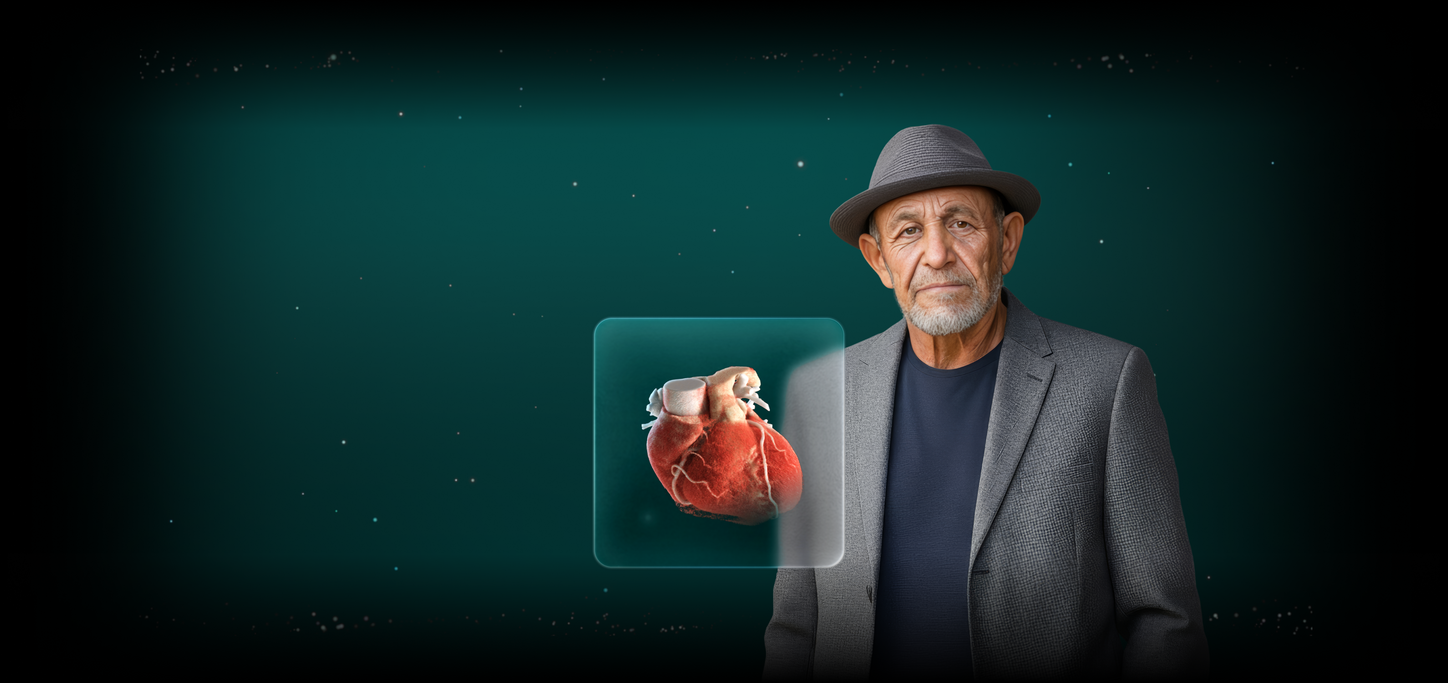
Cardiovascular
Care Pathway
Follow Claudio on his journey
1Epidemiology of aortic valve stenosis (AS) and of aortic valve incompetence (AI): is the prevalence of AS/AI similar in different parts of the world? Vol. 18, N° 10 - 12 Feb 2020 Dr. Roberta Ancona Dr. Salvatore Comenale Pinto
2Czarny MJ, Resar JR. Diagnosis and management of valvular aortic stenosis. Clin Med Insights Cardiol. 2014 Oct 19;8(Suppl 1):15-24. doi: 10.4137/CMC.S15716. PMID: 25368539; PMCID: PMC4213201.
3Courtesy of Piedmont Hospital.
4syngo.CT Coronary Cockpit CE labelled and US FDA 510k pending. It is not available for sale in U.S.A or other countries. The products/features mentioned herein are not commercially available in all countries. Their future availability cannot be guaranteed.
5Sobolev M, SlovutDP, Lee Chang A, Shiloh AL, Eisen LA. Ultrasound-Guided Catheterization of the Femoral Artery: A Systematic Review and Meta-Analysis of Randomized Controlled Trials. J Invasive Cardiol. 2015 Jul;27(7):318-23. PMID: 26136279
6ARTIS icono.explore floor with OPTIQ AI is pending 510(k) clearance, and not yet available for sale in the United States or any other countries.
7As low as reasonably achievable
8Within physical limits
9Dose reduction (based on phantom measurement) compared to conventional automatic exposure control, e.g. available with Artis Q, image quality is defined by contrast-to noise ratio
10Courtesy of SLK Kliniken Heilbronn, Germany
11Compared to conventional automatic exposure control (AEC) - e.g. available with Artis Q. In clinical practice, the patient dose reduction obtained by the feature described depends on the clinical task, patient size, C-arm angulation, and anatomical location. The dose reductions stated were assessed by using uniform phantoms and including mathematical models of the object sharpness and motion. Data on file and results may vary.
12Requires external 3rd party software applications.
13The dose reductions were achieved with the CNR-driven exposure control comparing to the detector-driven exposure control. They were obtained using a phantom composed of PMMA and aluminum plates to reproduce x-ray absorption and scattering in 2.5-40 cm ofpatient equivalent thickness. Contrast produced by a 0.25 mm thick iron foil, located in the isocenter, and the surrounding noise were measured. The contrast to noise ratio was calculated, considering the contrast- reducing (blurring) effects of the tube focus and object motion. Patientequivalent thickness refers to the physical thickness along the x-ray path excluding air cavities of a body having chemical element compositionidentical to the human body.
14Courtesy of Schieffer et al. UKGM, Germany, 2017
15Valve positioned in aortic annulus before deployment, Videos from AT CVC SHD Boston TAVR
16The products/features mentioned herein are not commercially available in all countries. Their future availability cannot be guaranteed.
17Courtesy of Semmelweis University, Budapest, Hungary.
18The product names and/or brands referred to are the property of their respective trademark holders.
19Fluoroscopy, DSA, native acquisitions, Roadmap, Overlay Ref
20Compared to predicate denoising functionality in VE40 ARTIS icono.explore floor with OPTIQ AI is pending 510(k) clearance, and not yet available for sale in the United States or any other countries.
21The dose reductions were achieved with the CNR-driven exposure control comparing to the detector-driven exposure control. They were obtained using a phantom composed of PMMA and aluminum plates to reproduce x-ray absorption and scattering in 20-40 cm ofpatient equivalent thickness, here referred as middle and high attenuations. Contrast produced by a 0.01 mm thick platinum foil, located in theisocenter, and the surrounding noise were measured. The contrast to noise ratio was calculated, considering the contrast-reducing (blurring) effects of the tube focus and object motion. Patientequivalent thickness refers to the physical thickness along the x-ray path excluding air cavities of a body having chemical element compositionidentical to the human body.
22Data on file. Results may vary by user.